

Editor’s Note: This article is part of a two-part series examining and challenging common arguments in favor of mass immigration. Part One addresses the cultural and social arguments, while Part Two focuses on the economic claims surrounding immigration and their implications for American workers and taxpayers. Part Two will be released later this week.
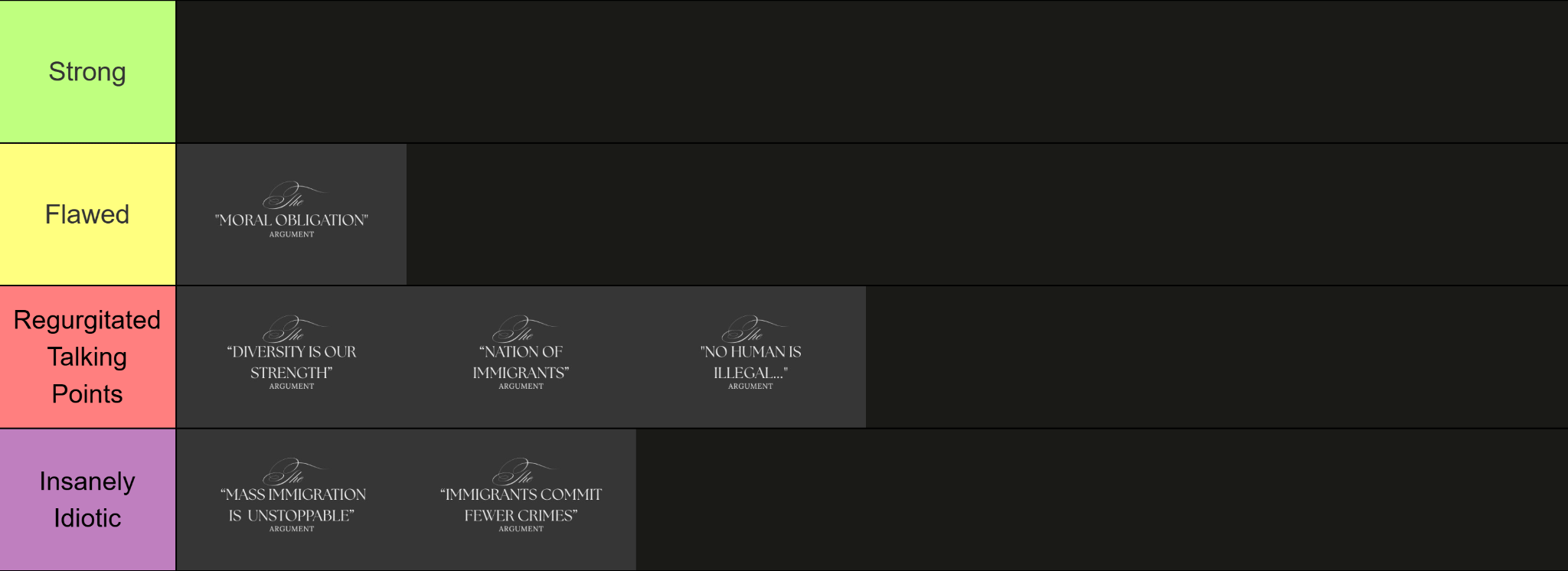
During the immigration boom of the late 1800s and early 1900s, America welcomed waves of legal immigrants who followed the law, assimilated, and worked hard to build the nation from the ground up. Today, however, that foundation is being undermined by a massive shift toward unchecked illegal immigration. Instead of strengthening the country the way legal immigrants did a century ago, those entering the country illegally today are overwhelming public resources, bypassing the rule of law, and tearing down the very systems our ancestors worked so hard to build. Equating the legal builders of America’s past with the crisis at our border today is the biggest flaw in the modern immigration debate. In this first installment of a two-part series, I will examine the most common cultural, social, and moral arguments in favor of modern immigration, ranking each on a tier list ranging from strong and flawed to regurgitated talking points and, finally, insanely idiotic arguments.
Before I start ranking each argument, allow me to first declare the difference between immigration and invasion, as I believe this is commonly misconstrued in modern times. An immigrant is someone who wants to assimilate into a culture and nation, they come from a compatible culture, they provide surplus value to the nation, and they respect local laws and customs of that nation. These traits are very important to any immigrant. However, there is an inverse to the standard definition of “immigrant”, and they are seen as an invader. An invader usually comes from an incompatible culture, does NOT want to assimilate to a new culture, would like to enforce his/her own norms onto a host nation, and often takes more than what they contribute to a cause. Pretending that today’s border crisis is no different from Ellis Island isn’t just historically dishonest; it is a dangerous delusion that is actively costing us not only our country, but many others as well.
Whenever the failures of modern immigration policy are questioned, defenders inevitably hide behind the rehearsed slogan, “Diversity is our strength.” Yet history and common sense prove the exact opposite: unity is our strength. While a diversity of ideas and open debate actually makes a free society sharper, the people shouting this slogan the loudest are usually the ones demanding strict ideological conformity while celebrating cultural division. Look at the global stage—from the high-trust, low-crime societies of East Asia to any successful institution in history—and it is obvious that unified cultures with shared values and a common language objectively outperform fragmented ones. America’s historical success never came from importing separate cultures to live in divided pockets; it came from the melting pot, proving that assimilation, not unchecked diversity, is our true strength. This argument is easily a regurgitated talking point.
Another pillar of the open-borders playbook is the endless repetition that America is a “nation of immigrants”—a hollow slogan masquerading as a serious historical argument. When critics use that phrase today, they conveniently ignore a basic question: immigrants from where? Throughout the nineteenth and early twentieth centuries, the vast majority of newcomers arrived from Western, Judeo-Christian nations and shared the foundational values of the civilization that built the United States, allowing them to assimilate rapidly into the American fabric. Most everyday Americans still welcome legal immigrants who are eager to adopt our culture, respect our laws, and embrace our way of life. However, modern immigration advocates are using this nostalgic phrase to justify importing millions of people from regions with fundamentally incompatible values and a proven refusal to assimilate—turning a proud historical motto into a cheap rhetorical shield. Yet another regurgitated talking point.
When all other excuses fail, open-borders advocates fall back on a counsel of despair, claiming that mass immigration is simply an unstoppable force of nature. This is completely false, and plenty of sovereign nations around the world prove it every single day by enforcing their laws and securing their borders. Consider Japan: even while facing an aging population and a collapsing birth rate—the exact demographic excuses Western politicians use to justify endless migration—Japan still maintains strict control over its borders and refuses to sacrifice its national identity for cheap labor. If a nation under that level of demographic pressure can protect its sovereignty, the richest and most powerful superpower in human history has zero excuse. Ultimately, the myth that mass migration is “unstoppable” isn’t a serious policy diagnosis; it is a calculated tactic designed purely to demoralize citizens into accepting a crisis that our leaders simply refuse to stop. This argument is the first of our lowest category: insanely idiotic.
One widely circulated argument in this debate is the claim that immigrants commit fewer crimes than native-born citizens, a heavily engineered statistic that relies on selective data to obscure reality. These studies routinely exclude second-generation crime rates, which spike dramatically, ignore how deportations artificially suppress repeat-offender statistics, and compare the entire domestic population against a carefully filtered, self-selected subset of legal migrants. Even then, the supposed safety gap evaporates the moment analysts separate vetted, high-skilled professionals from unvetted, low-skill mass inflows. For anyone paying attention to the surge in violent crime and social unrest across European cities, and increasingly within American communities, insisting that unchecked migration poses no threat to public safety isn’t merely misleading; it is a cruel distortion of reality aimed at silencing the communities forced to live with the consequences. This argument is absolutely idiotic.
After their other arguments collapse under examination, immigration advocates inevitably retreat to emotional blackmail, insisting that we have a “moral obligation” to let anyone across our border. Yet the very people lecturing the public about borderless compassion still lock their own front doors at night, recognizing in their personal lives what they deny in public policy: that boundaries exist to protect the people inside. Wanting to help those in genuine crisis is admirable, and offering sanctuary to vetted refugees who share compatible values and a willingness to assimilate is entirely reasonable. However, genuine humanitarian relief means relocating displaced populations to stable, neighboring countries that share their language, religion, and cultural norms—and the fact that wealthy neighboring nations routinely refuse to take them in is deeply telling. Ultimately, charity cannot come via national suicide; a government is not a global charity, and its primary, non-negotiable moral obligation is to the safety, prosperity, and security of its own citizens. Our first argument for the “flawed” category.
The debate frequently bottoms out with the bumper-sticker platitude that “no human is illegal”—a cute slogan, I will say, but that collapses the moment it meets reality. This exact hypocrisy was on full display when pop star Billie Eilish sparked massive backlash at the Grammys by declaring from the stage that “no one is illegal on stolen land.” Critics immediately pointed out the obvious irony: Eilish retreats each night to a $14 million Los Angeles mansion fortified by gates, walls, and private security—built on ancestral Tongva land she has zero intention of surrendering to strangers. Like so many wealthy elites, she fiercely enforces borders around her own home while demanding that working-class Western communities erase theirs. Every sovereign nation on Earth maintains borders to preserve order, security, and the rule of law; expecting our government to enforce ours isn’t a denial of anyone’s humanity; it is the bare minimum required for a country to exist. This argument matches other regurgitated talking points.
Ultimately, the modern immigration debate relies on outdated nostalgia, cherry-picked statistics, and hollow moral platitudes designed to mask a failing system. Whether defenders are hiding behind slogans about “diversity” and a “nation of immigrants” or lecturing everyday citizens from behind the gates of their own estates, every single one of these arguments collapses under honest scrutiny. The America of the late 1800s succeeded because it demanded legality, shared values, and assimilation—not because it treated its borders as optional. A nation is not an economic zone or a global charity; it is a home, and until our leaders reject these flawed talking points and put the security, wages, and unity of their own citizens first, the crisis at our border will only continue to tear down what past generations worked so hard to build.
Be sure to check out the second installment of this series, where we will discuss the most common mercantile and economic arguments in favor of modern immigration, continuing this tier list.